

Research reveals racial and ethnic disparities in exposure to security personnel in US high schools
Black and Hispanic students experience greater exposure to security personnel than White students

© Flex_Point_Security / Adobe Stock
New research published in Educational Evaluation and Policy Analysis reveals substantial racial and ethnic disparities in students’ exposure to security personnel in US high schools.
Using data from the 2017–2018 and 2020–2021 Civil Rights Data Collection (CRDC), the researchers examined racial and ethnic differences in students’ exposure to security personnel in US high schools and how these disparities are distributed across different geographic levels. Significantly, the study distinguishes between law enforcement officers and school security guards, enabling the researchers to identify differences in how these roles are deployed.
The study found that, on average, Black students attended schools with approximately one additional security staff member per 1,000 students compared with schools attended by White students in both 2017-18 and 2020-21.
Co-authored by DSPI’s Dr Ismael G. Muñoz, the findings also highlight the importance of examining how security personnel are distributed and how these patterns intersect with school funding, racial segregation, and poverty. The researchers argue that these factors are significant because they can shape decisions that prioritise supervision and security over other student and school support.
Commenting on the research, Dr Ismael G. Muñoz said:
'Our findings suggest that reform should not only focus on officer presence within schools but also on structural inequalities in security personnel deployment by type and across districts and regions.'

Key findings
The research, ‘Beyond School Police Officers: Racial/Ethnic Disparities in Exposure to a Fuller Range of School Security Personnel’, found:
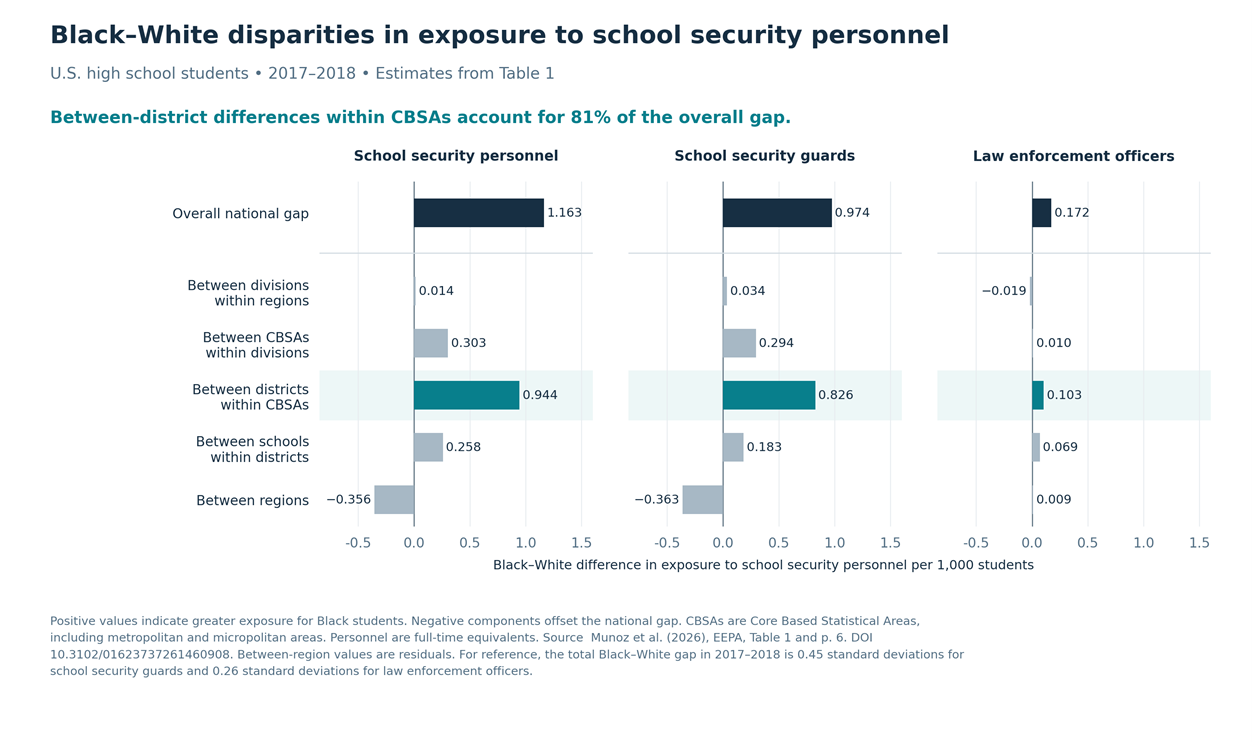
- Racial and ethnic disparities in exposure to security personnel in US high schools are primarily driven by school security guards rather than sworn law enforcement officers.
- For Black students, approximately 81% of the disparity happens between school districts within the same metropolitan areas.
- Racial segregation is the strongest predictor of differences across metropolitan areas in Black-White and Hispanic-White exposure to school security guards.
Credit: Associate Professor Kenneth Shores (University of Delaware)
Implications for policy
The findings suggest that efforts to address racial disparities in school security should consider not only the presence of sworn law enforcement officers but also the deployment of school security guards, who account for much of the observed disparities.
The geographic distribution of these disparities also highlights the need to understand and reshape district-level practices, particularly in urban areas where disparities between school districts within the same metropolitan areas are most pronounced.
The researchers highlight the need for further research into how school security decisions interact with broader issues such as of school funding, racial segregation and poverty, as well as the roles and practices of school security guards.
About the research
The study was co-authored by Dr Ismael G. Muñoz (DSPI), Associate Professor Kenneth Shores (University of Delaware), Assistant Professor Ericka S. Weathers (University of Pennsylvania), and S. Colby Woods (University of Pennsylvania).