

Evidence-Based Social Intervention and Policy Evaluation Master's Programmes

Credit: John Cairns
We offer two Master's courses in Evidence-Based Social Intervention and Policy Evaluation (EBSIPE):
All societies face complex social challenges, prompting the development of policies and interventions aimed at improving health, education, and wellbeing, addressing structural inequalities and promoting social justice. The MSc and MPhil in EBSIPE are designed to provide high-quality graduate level research training in concepts and methods for evaluating social interventions and policies.
Rigorous methods training
Our papers emphasise research and evaluation methods (quantitative, qualitative, randomised trials, advanced quasi-experimental methods) for social scientists, evidence synthesis and critical appraisal of evidence, intervention development and adaptation, as well as the advanced study of evidence-based policy and practice.
Evidence for policies and programmes
Our courses have an interdisciplinary and international perspective focusing on appraising, generating and using evidence in policy and practice with an emphasis on ethics and equity. Key areas of focus include poverty reduction, child and family services, education, violence and injury prevention, mental health, substance use, HIV prevention and other social issues.
Application deadline
Monday 7 January 2027, 12:00 midday UK time.
Structure of the courses
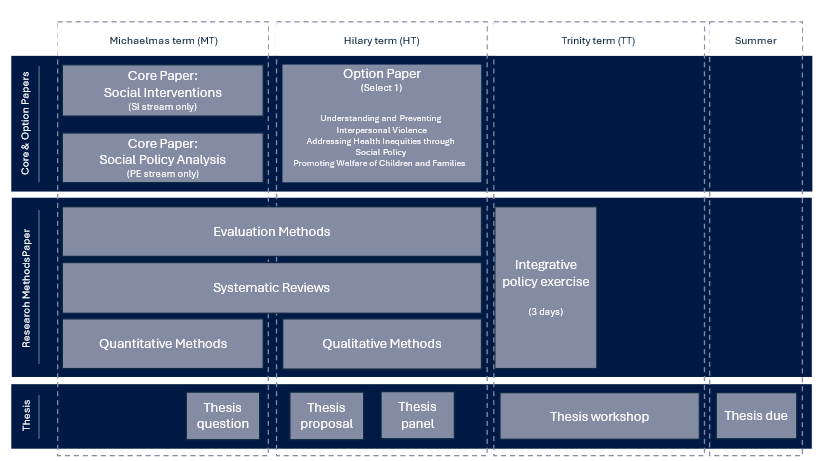
In Michaelmas Term (October – December):
Core papers: 1 Module (different for Social Intervention and Policy Evaluation students)
Social Interventions (SI stream)
Social Policy Analysis (PE stream)
Research Methods papers: Modules are the same for SI and PE students.
Evaluation Methods
Systematic Reviews
Quantitative Analysis
Exams and Research:
Methods Assignments
In Hilary Term (January – April):
Research Methods papers: Modules are the same for SI and PE students.
Evaluation Methods
Systematic reviews
Qualitative Methods
Options Papers: 1 Module chosen by student (Example options below, subject to change)
Welfare of children and families
Community analysis and large-scale interventions
Health: policy and Inequalities
Exams and Research:
Methods Assignments
In Trinity Term (May – August):
Core Papers: Policy Exercise (both streams)
Research Methods papers: Modules are the same for SI and PE students.
Evaluation Methods
Systematic reviews
Advanced Methods (optional/offers vary)
Exams and Research:
Exams/Assessments (Core/Option)
MSc Thesis
Students on the two-year MPhil will have a further option course, and research thesis submitted in the second year.
On the EBSIPE course, you can focus on the evaluation of micro-level social interventions or macro-level social policies. These represent two distinct pathways structured around a shared core.
The shared courses comprise classes on research design, statistics, qualitative analysis, systematic reviewing and critical appraisal. The courses prepare you to be critical consumers of research, and to design and implement your own research projects. You cover key research designs, as well as quantitative and qualitative techniques for measuring process and outcome. There is a particular emphasis on appraisal and design of randomised controlled trials, quasi-experimental designs and systematic reviews, and their application to social interventions and policy evaluation.
In addition to the common courses, you will select (after a trial week in Term 1) from the following two pathways:
-
The Social Intervention pathway covers theories underlying interventions (such as changes to alcohol trading hours or parenting training); conceptual foundations of evidence-based practice, and the science behind development, cultural adaptation, testing, and implementation of social interventions in the real world. You are taught through lectures, practicals and case studies of interventions for different social problems, led by experts in these applications.
-
The Policy Evaluation pathway introduces you to evidence-based social policy analysis. Policy analysis examines the process of policy-making, the setting of objectives, the choice and design of policy, and the mechanisms of implementation.
You will take specialist courses (one in the MSc or two in the MPhil) from a list of options focusing on a particular policy area, vulnerable group or analytical approach. Past options covered topics such as children and families, community analysis and intervention, health inequalities and social policy.
Teaching in some options may not be available every year.
On both pathways, you will write a thesis on a topic of your choice, agreed with your supervisor. Assessment is based on a combination of examinations and/or submitted coursework assignments throughout the year.
Supervisor
You are allocated a supervisor in the department, who provides academic guidance oversees your progress. Other departmental staff are also available to provide guidance, including staff leading lectures and classes, the Director of Graduate Studies, and the DSPI administrative team.
College Tutor
You are also allocated a college tutor who is responsible for your general welfare and who can provide guidance on any challenges on the academic or social side.
In addition, you can draw on University-wide support as needed, such as Women's Advisors and Chaplains in colleges and ultimately to the Head of the College. The University has a counselling service which provides advice, both immediate and long term, to students in need. There are college nurses and all colleges have a college doctor and many a college dentist.
Course Director
Your programme will be led by a Course Director, working with a close-knit team of teachers and supervisors. The Course Director takes overall responsibility for co-ordinating teaching, arranging specialist supervision for option papers and thesis writing.
Profiles of current students can be found on our Master's students page and you can take a look at our student videos. Graduates from our programme go on to pursue academic careers in world-leading research universities, while other alumni hold influential positions in government, non-governmental and international organisations such as the World Bank, the World Health Organisation, and the UN.
Oxford 1+1 MBA Programme
The Oxford 1+1 MBA programme provides high calibre candidates with the opportunity to apply to both the Comparative Social Policy MSc programme and the MBA programme offered by the Saïd Business School.
ESRC 1+3.5 Doctoral Training
These programmes can be part of a 1+3.5 ESRC University Doctoral Training Centre scholarship. Find out more on the doctoral training site.
TrygFonden Scholarship
The TrygFonden Scholarship is available for students resident in Denmark studying the MSc in Evidence-Based Social Intervention and Policy Evaluation. Find out more on the University of Oxford's A-Z of scholarships.
Some funding is available through the University of Oxford (see below) but you are strongly encouraged to apply for non-Oxford funding sources. You should consider funding for their studies as early as possible.
A guide to the fees and funding can be found on the University of Oxford fees and funding pages.
University of Oxford scholarships
Applications received by the funding deadline for your course will be automatically considered for a number of scholarships available through the university, its colleges and other funds managed by both.
The range of scholarships and eligibility criteria can be found through the University fees and funding search tool.
External scholarships
Given the strong competition for funding applicants are strongly encouraged to also seek out scholarships offered by non-University of Oxford bodies.
A list of outside funders linked with the University of Oxford can be found on the University funding pages.
To find detailed information about the application process, including deadlines and required documents, please visit:
- MSc in Evidence-Based Social Intervention and Policy Evaluation
- MPhil in Evidence-Based Social Intervention and Policy Evaluation
For general advice on applying to graduate courses, visit the University of Oxford Graduate Admissions page.
For specific questions or to hear more about the department, academic staff and our application procedure, please contact our admissions officer: admissions@spi.ox.ac.uk
Further Information
The Master’s programmes in EBSIPE are designed to provide you with high quality graduate level research training in the concepts and methods used to evaluate social interventions and policies. We emphasise research methods for evaluating interventions and policies, as well as the advanced study of evidence-based policy and practice. This could be in areas such as poverty reduction, child and family services, education, violence and injury prevention, mental health, refugees, drug and alcohol abuse, and HIV prevention.
The core aim of the course is to help you develop the ability to design and critically appraise intervention and policy evaluation studies. It also enables you to apply your research findings to informing policy and practice.
The aims of the course are for students to:
- Develop critical appraisal, problem solving and research methods skills in the field of evidence-based interventions and policies for social problems.
- Critically assess and evaluate the political, economic, social, and policy factors that shape social problems and social inequalities
- Learn how to develop, analyse, and evaluate social interventions and develop awareness of key conceptual and methodological issues in intervention research.
- Understand the ways in which research findings concerning evidence-based interventions and policies can be transferred into practice and the challenges and possibilities associated with transferability.
- Apply the skills necessary for carrying out further research in this field, and where applicable, to progress as leading practitioners or senior managers in agencies for social intervention, policy makers, policy analysts, and policy and programme evaluators.