

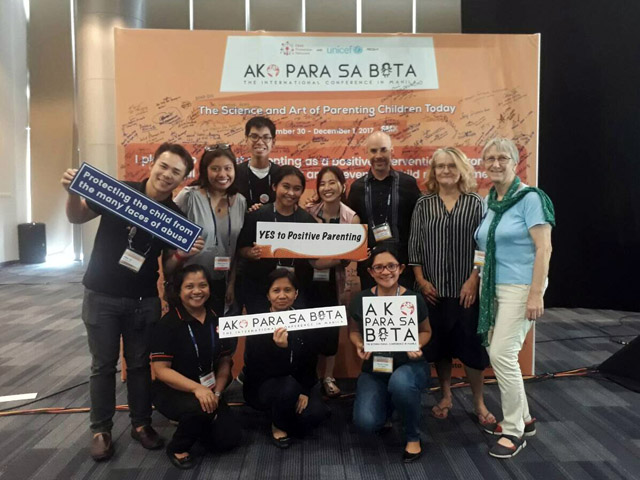
Preventing Violence Against Children in the Philippines
Principal investigator: Professor Jamie M. Lachman and Professor Frances Gardner; Professor Liane Alampay (Ateneo da Manila, the Philippines)
Funded by: UBS Optimus Foundation, UNICEF Philippines
Start date: 2016
End date: 2022
Project outline
This study developed and tested Masayang Pamilya Para sa Batang Pilipino, known as MaPa, a culturally adapted parenting programme for low-income Filipino families with young children. The work took place in the Philippines between 2016 and 2022 and focused on families participating in the country’s conditional cash transfer system.
MaPa adapted Parenting for Lifelong Health for Young Children for the Filipino context. The study tested whether an evidence-based parenting programme could reduce violence against children, strengthen parenting practices and fit within a major government social welfare system.
Significance
The Philippine government’s Pantawid Pamilyang Pilipino Program, known as 4Ps, reaches large numbers of low-income families. Embedding parenting support within this system offered a practical route for reaching caregivers who may otherwise have limited access to evidence-based family support.
The study also addressed a wider implementation question: how can a parenting programme developed in one country be adapted responsibly for another culture, language and service system?
Implementation
The team worked with Filipino parents, practitioners, researchers and government partners to adapt Parenting for Lifelong Health for Young Children into MaPa. The adaptation process considered language, family norms, examples, delivery style and the realities of families receiving support through 4Ps.
The team tested MaPa through feasibility work, a pilot randomised controlled trial and a randomised controlled trial embedded within the 4Ps system. The study examined violence against children, parenting practices, child behaviour, parental mental health and family wellbeing.
The work involved Oxford researchers, Ateneo de Manila University, the Philippine Child Protection Network, the University of Cape Town and the Philippine Department of Social Welfare and Development.
Findings
The trial found that Masayang Pamilya reduced violence against children when delivered through the Philippines’ conditional cash transfer system. It also showed improvements in positive parenting, supporting evidence that parenting programmes can be delivered effectively through existing social welfare platforms.
The study demonstrated that a Parenting for Lifelong Health intervention could be carefully adapted for Filipino families while retaining its core evidence-based components. The South-to-South adaptation process helped ensure that MaPa reflected local language, family life, caregiving norms and frontline delivery realities.
These findings gave MaPa a strong evidence base as a culturally adapted parenting programme for low-income Filipino families. They also showed the value of working through national social welfare systems to reach families who may otherwise have limited access to structured parenting support.

- Lachman, J. M., Alampay, L. P., Jocson, R. M., Alinea, C., Madrid, B., Ward, C., and colleagues. (2021). Effectiveness of a parenting programme to reduce violence in a cash transfer system in the Philippines: RCT with follow-up. The Lancet Regional Health: Western Pacific, 17, 100279.
- Mamauag, B. L., Alampay, L. P., Lachman, J. M., Madrid, B. J., Hutchings, J., Ward, C. L., and Gardner, F. (2021). A South-to-South cultural adaptation of an evidence-based parenting program for families in the Philippines. Family Process, 60(4), 1202-1216.